
Study overview
CEPI Eurokraft contracted RISE (Research Institutes of Sweden) to calculate the potential cradle-to-filler out contribution of global warming of paper sacks (manufactured from virgin sack kraft paper) and woven polypropylene (WPP) sacks (manufactured from virgin polypropylene) for packaging 50 kg of cement in markets outside of Europe. The results are then applied to compare the two solutions in each market, with a view to understanding the differences in the carbon footprint of paper sacks and WPP sacks for cement and identifying the factors that have the most influence over relative standing of the two solutions. Sensitivity and uncertainty analysis shows that the results achieved, and conclusions drawn are robust, and the study has been peer reviewed by the Sustainability in Metrics (SIM) team at SimaPro UK.
Methodology
This life cycle study focuses on the fossil global warming potential for the studied systems and follows the requirements of ISO14040/14044.
The study investigates paper sacks and WPP sacks for cement in four specific markets:
Africa – represented by a case study considering Ivory Coast
Middle East – represented by a case study considering Saudi Arabia
South/Central America – represented by a case study considering Mexico
South East Asia – represented by a case study considering Indonesia
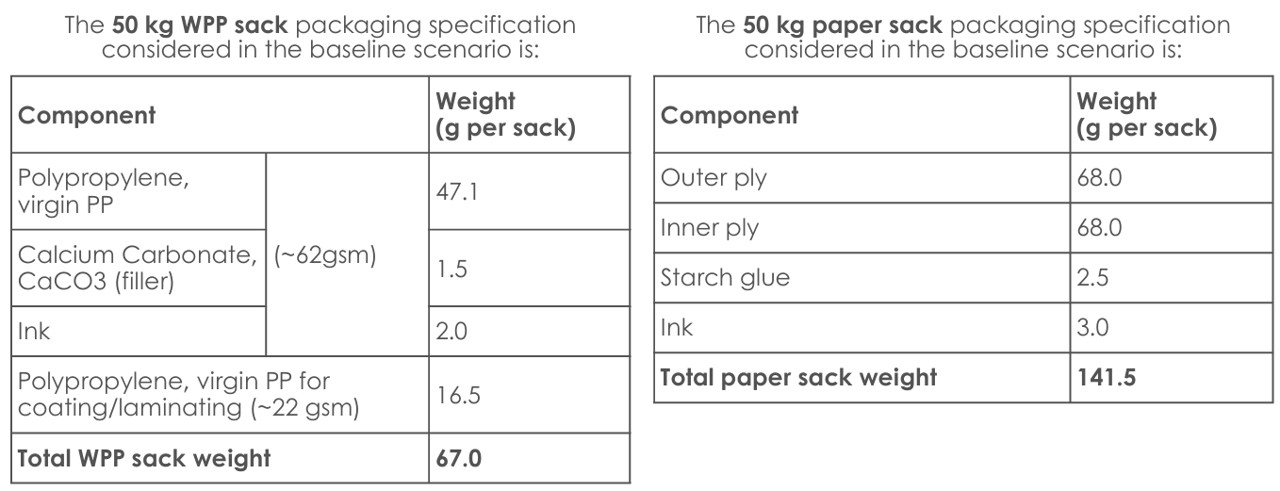
For this study, the system boundaries are “cradle to filler out gate”, as these represent the life cycle stages where the sack supplier and filler have control over the potential impacts.
For the WPP cement sack this covers the production of the PP granules, transportation to a converter, production of a tape which is then weaved into a substrate, coated/laminated, printed and formed into WPP sacks in an integrated process, and then transported to a cement filler. At the filler, the sack is filled with cement.
The system boundaries for the paper cement sack cover the production of sack kraft paper in Europe, transported to the specific market outside Europe, production of paper sacks in a sack converting plant, distribution to a filler and finally the filling process with cement.
The figures used for evaluating paper sack production are mainly primary data. They are taken from representative European paper mills, paper converters and machinery manufacturers. GHG emissions for purchased electricity in the case study countries are sourced from the International Energy Agency (IEA) website and GHG emissions related to transportation have been sourced from EcoInvent 3.10. Finally, the GHG emissions from filling operation have been sourced from a literature review.
Figures used for evaluating the WPP sack system are mainly taken from EcoInvent 3.10 database, International Energy Agency (IEA) website and literature review.
Key takeaways

- For both packaging solutions, production of the raw materials makes the highest contribution to the fossil global warming potential. In the case of paper sacks, the majority of this impact is due to the production of sack kraft paper ready for conversion into paper sacks. In the case of WPP sacks, most of this impact is due to the production of polypropylene granules ready for conversion into WPP sacks.
- Sack conversion has a higher impact for WPP sacks compared to paper sacks, due to the higher electricity demand for converting PP granules into sacks in an integrated process compared to converting sack kraft paper into sacks.
- Inbound logistics has a higher impact for paper sacks compared to WPP sacks. This is due to the fact that the sack kraft paper is produced in Europe and must be transported long distances to the converter, whereas PP granules are produced more locally. Furthermore, the paper sacks are heavier compared to the WPP sacks and therefore more weight of raw materials must be delivered to the converting site.
- Outbound logistics has a higher impact on paper sacks compared to WPP sacks. This is because the paper sacks are heavier compared to the WPP sacks and therefore more weight of packaging must be distributed.
Conclusion
Overall, according to the baseline scenarios considered, for all market case studies the total cradle-to-filler out-gate fossil global warming potential impact of WPP sacks for 50kg of cement is approximately twice as high as the fossil global warming potential impact of paper sacks for 50kg of cement.
A short video summarizes the study:
More information
- Fact sheet: “Comparative Carbon Footprint study“
- Carbon Footprint report: “Comparative carbon footprint study: Paper sacks versus woven PP sacks in markets outside Europe“